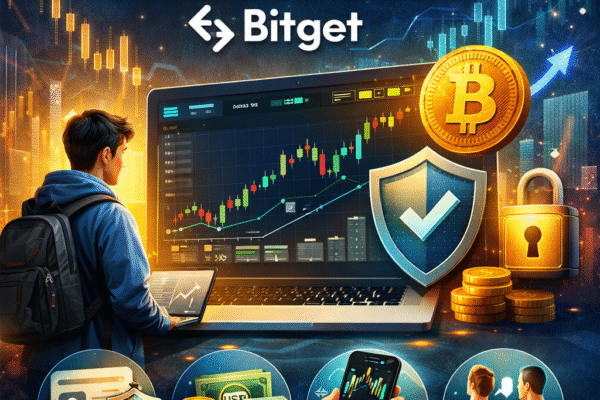
How Beginners Can Start Crypto Trading Safely in 2026 (Step-by-Step Guide Using Bitget)
Introduction: Why 2026 Is Still a Big Opportunity for New Traders Crypto isn’t “too late.” It’s just more mature. With global adoption increasing and platforms like Bitget simplifying access to markets, beginners now have better tools, stronger security, and more transparency than ever before. But here’s the truth:Most beginners don’t lose money because crypto is…

Invite Friends to Bitget: You Both Earn $60 in BTC + Mystery Boxes Worth Up to 1,500 USDT
Crypto rewards are getting more competitive in 2026, and exchanges are stepping up their incentive programs. One of the more attractive campaigns right now comes from Bitget, offering new users and their referrers a chance to earn $60 in BTC airdrops plus Mystery Boxes worth up to 1,500 USDT each. If you’ve been considering opening…
How to Earn Passive Income with BingX: Refer Friends and Get Up to 50% Commission
Crypto isn’t just about price speculation. Savvy traders know that real opportunity comes from building sustainable income streams — even while you sleep. One of the most effective ways to do this is through exchange referral programs. BingX offers a professional, scalable solution: earn up to 50% commission simply by inviting friends to the platform….
Earn $100 in Gold (XAUT) With BingX – Invite Friends & Earn Together
Crypto rewards are common. But getting paid in gold-backed crypto? That’s different. Right now, BingX is running a referral campaign that lets you earn up to $100 worth of XAUT simply by inviting friends. Here’s how it works. What Is the BingX “Earn Together” Campaign? BingX is offering a limited-time promotion: Simple structure. No complicated…

How to Get the Binance $100 Sign-Up Bonus in 2026 (Step-by-Step Guide)
Crypto exchanges compete aggressively for new users — and in 2026, Binance is offering up to $100 in sign-up rewards for eligible new accounts. But here’s what most people don’t realize: The bonus is real — but it comes with conditions. This guide explains exactly: Let’s break it down step-by-step. What Is the Binance $100…

Earn Passive Crypto Income with Binance in 2026
Turn Your Idle Crypto Into Daily Rewards Most crypto investors focus on price. Smart investors focus on cash flow. If you’re holding crypto anyway, there’s no reason it should sit idle. With Binance, you can earn passive income directly from your existing assets — without trading, without complex DeFi strategies, and without chasing risky 100%…
Bitcoin Price Trends Explained: What Drives BTC in 2025
Key Takeaways Bitcoin no longer trades on speculation alone. By 2025, BTC has transitioned into a macro-sensitive digital asset influenced by liquidity cycles, institutional positioning, and long-term supply dynamics. While volatility remains part of Bitcoin’s identity, the forces shaping its price are more visible—and more structural—than in earlier market cycles. Understanding Bitcoin price trends in…

SUI Object Storage: The Next Big Disruption in Blockchain Architecture
Key Takeaways: By 2025, blockchain scalability is no longer just about faster transactions—it is about how data itself is structured and accessed. Traditional account-based blockchains struggle under the demands of modern applications such as on-chain games, social platforms, and real-time asset systems. These use cases require frequent state changes, parallel execution, and low latency. SUI…

Toncoin Mini-Apps in Action: Transforming Web3 User Experience
key takeaways: By 2025, blockchain technology is no longer limited by raw capability—it is limited by usability. Wallet setup, gas fees, confusing interfaces, and fragmented ecosystems continue to prevent mainstream adoption. This is where Toncoin (TON) and its rapidly expanding ecosystem of mini-apps are making a meaningful difference. Built around deep integration with Telegram, Toncoin…

Avalanche & Polkadot Multichain Wars: Which Model Is Winning Developers
Key Takeaways: By 2025, the blockchain industry has largely agreed on one thing: a single chain cannot scale to meet global demand. The future is multichain. What remains contested is how that multichain future should be built. Avalanche and Polkadot represent two of the most influential but fundamentally different approaches to multichain architecture. Both aim…